
You swim three times a week. You can ride a bike for an hour without thinking about it, you are not out of shape by any honest measure. Then someone slides past you in the next lane looking like they are barely working.
Nothing is wrong with your fitness. You are losing time to water, not to your heart and lungs, and those are different problems.
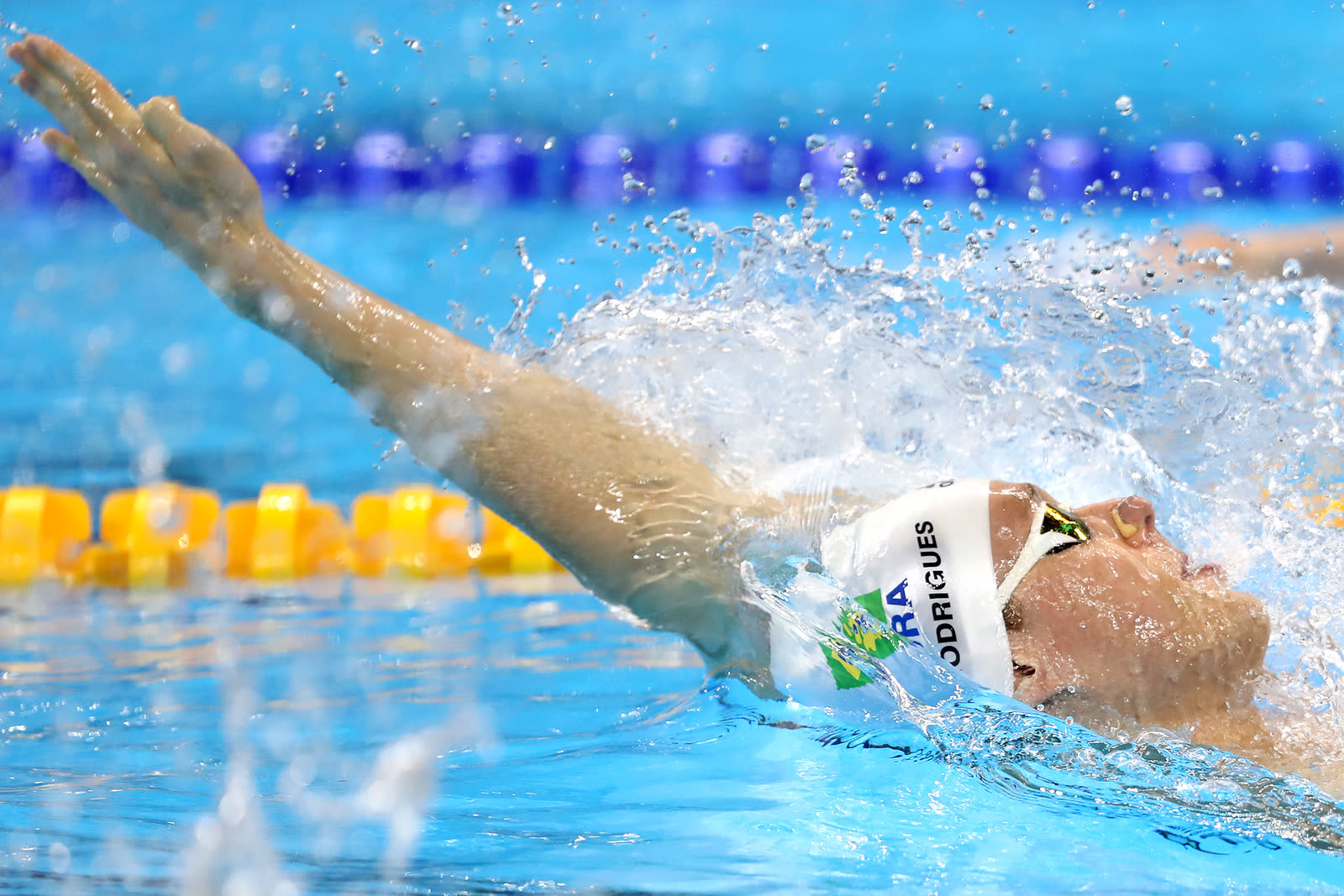
Why am I so slow at swimming when my fitness is fine?
Because in the water your speed is decided less by what you produce and more by what you stop losing. Cycling rewards the engine. Swimming taxes the shape.
U.S. Masters Swimming puts the split cleanly in its freestyle guide: "Increasing propulsion is a result of physical training and technical skill whereas reducing drag comes from improved skill." Then it says what that means for the swimmer who trains and does not improve: "No matter how much consistent training you do, it's difficult to overcome the limitations of poor technique."
I spent my career inside the 200 individual medley, and what separated swimmers at every level I raced at was rarely conditioning. It was how much water each one was dragging along. Four faults do most of that damage in an adult freestyle, and they come in this order on purpose.
Is your head riding too high in the water?
If you can see the far wall while you are swimming, yes. A high head sinks the other end of you, and every stroke after that is pulling a tilted body instead of a long one.
The USMS body position guide uses a seesaw to explain the fix: "The first strategy is to press your head and chest, the lighter end of the seesaw, down into the water." The target for the whole body is checkable on video: "Everything needs to be as straight as possible from head to toe, minimizing any drag."
This is first for a reason. The guide ranks it above everything else: "Maintaining a great body position is the most important skill for swimming freestyle fast." If your head is high, nothing below it is worth fixing yet. More in freestyle head position.
Why do your legs sink when you kick harder?
Because the lift does not come from your legs. It comes from the tension you hold through your lower back and hips, and kicking harder does not create it.
The body position guide names the source: "Your lower back and hips are key for creating tension in the back of your body." And what that tension buys you: "This tension holds your legs up at the surface of the water, preventing them from sinking."
Kicking harder instead is the most expensive mistake on this list, because effort feels like speed. The USMS freestyle kick guide prices it: "The bigger your kick, the more energy you need." The return does not follow: "A bigger kick doesn't necessarily create more propulsion," and worse, "Thus, a progressively larger kick creates progressively less additional propulsion."
That is the adult swimmer's trap. You pay more for less, arrive at the wall gassed, and blame your fitness. If this is you, start with why your legs sink when you swim.
Why does your pull feel like it slips?
Because your hand and forearm are not facing backward when you start pushing, so you are shovelling water down and out instead of sending it behind you.
The USMS freestyle pull guide never uses the phrase dropped elbow. It describes the position you want instead: "To pull effectively, have your hand and forearm facing backward." Getting there is one small move: "drop your hand down and in from the outstretched position" "while your elbow bends, pointing out to the side." The finished shape is checkable from the side of the pool: "The end position is one in which your hand is deep and your elbow is pointed out to the side."
What goes wrong is almost always hurry. The guide says so directly: "Attempting to rush or overpower your catch can lead to mistakes," and names the result: "This typically results in your arm failing to orient backward prior to pulling." More in the freestyle catch.
Are you letting go of the water before your hip?
Most tired adult swimmers are. The arm comes out early, the stroke rate climbs, and the part of the pull that was moving you forward gets cut off.
The pull guide gives you the reference point: "As a good point of reference, your hands should finish your pull just past your hips." It allows for how you are built: "If your arms are short, you might pull just to your hip, whereas you might pull well past your hip if your arms are particularly long."
An early exit costs so much because of where it happens. The guide locates the engine in the middle: "The main propulsive phase of freestyle is the middle of your pull, after your catch and before the exit." A high stroke count with a short pull is the signature of a swimmer working hard and going nowhere. Finishing the push phase past the hip has the detail.
So should you stop training and only do drills?
No. You need both, and the guide says so: "Take the time to sharpen your skills and to develop the right physical traits." What changes is what you expect from each. The freestyle overview frames endurance in water as an efficiency problem first: "improving your endurance is all about reducing how much energy it takes you to move forward through the water." Keep the sessions. Stop expecting them to fix a shape problem.
How will SwimRead read these four mistakes?
The app isn't out yet. When it launches, it will read freestyle from a side view clip, the angle where head, hips, and both ends of the pull sit in one frame. The SwimRead home page states that "At launch, the app will analyze freestyle filmed from the side of the pool," and that "On-device pose detection estimates up to 33 body landmarks in sampled video frames."
The page also gives the clip to film. "Aim for 10 seconds of continuous freestyle," shot so that you "Film in landscape from the side, with the whole body visible, a stable camera, standard lens, and normal playback speed." Whole body visible is the part people skip, and it decides whether your hips and your hand exit are in frame at all.
It also tells you what it does not do. The page says "The report distinguishes available measurements from categories the video cannot support," and states plainly that "These estimates are not validated technique grades." Use the clip the way I would on the deck, as a record of what your body actually did, not as a score.
What should you take to the pool this week?
- Check the head first. One 25 looking straight down, pressing your chest in. If your hips rise, you found your fault.
- Stop kicking for one length. Hold tension through your lower back and hips with a small kick, and see whether your legs stay up without the effort.
- Pause the catch. Swim 4 x 25 slowly, taking an extra beat with your forearm facing backward before you push.
- Count your strokes per length. Then swim one length finishing every pull just past your hip and count again. A lower count at the same effort is the pull you were losing.
- Time the same 100 twice. Your usual way, then with the four checks, and log both in my free swim pace calculator.
The SwimRead app isn't out yet. If you want help with your stroke today, take the 60-second swim check.