
Most adult butterfly fails underwater, not over it. The arms come around, the hands go in, and something vague happens below the surface before they pop out again. The effort shows up in the shoulders and never in the speed.
Butterfly is unforgiving that way. In freestyle one arm is always in the water, so a weak pull gets covered by the other side. In butterfly both arms pull and recover together, so the hands get one window per cycle to produce everything.
The 200 individual medley starts with butterfly, so I spent two Olympic Games building a first leg that had to be fast and still leave something for three strokes afterwards. You do not get that by pulling harder. You get it by knowing what the hands should be doing underwater.
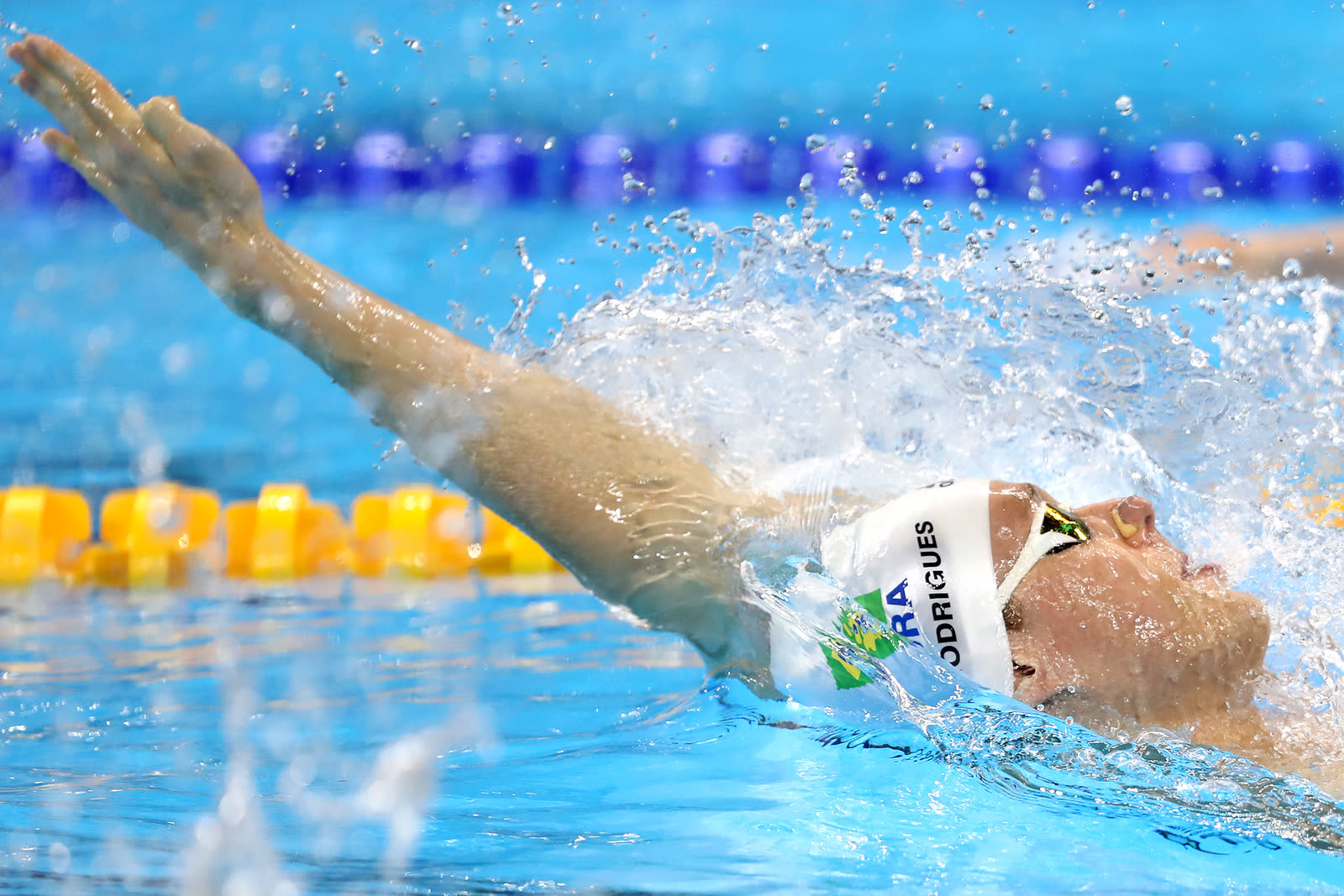
How should your arms pull in butterfly?
Your hands enter in front of the shoulders, press out and down to set a catch, sweep in towards each other under your chest, then accelerate backwards past your hips and out of the water. The hands speed up as they go, and the fastest part of the pull is the last part.
The pull is not a shape you trace at constant speed. It starts slowly and finishes fast.
US Masters Swimming describes the backward part plainly in its butterfly pull guide: "Keep moving your hands and forearms backward as a unit." On direction: "To create as much forward speed as possible, try to pull directly backward because that will move you forward." Water pushed sideways or down moves you sideways or up, which is how a stroke that feels like work still goes nowhere. If the entry is your problem, fix that first with how to swim butterfly.
What are the phases of the butterfly pull?
Four of them: entry, outsweep, insweep and upsweep. They are not coaching invention, they are how the stroke gets measured.
A study of butterfly swimmers on PubMed Central, on hand velocity and swimming speed, defines each phase by what the hand is doing. The entry is the "period from touch of hand in water till its full extension and forward gliding". The outsweep runs "from the full hand's extension till achieves the most deep vertical position". The insweep begins "from the most deep vertical position of the hand". The upsweep goes "from the end of insweep till achieve the legs level, after backward extension of the arms".
Read those boundaries and you can see how long the stroke really is. The hand does not start working the moment it touches the water. It extends forward first, and swimmers who grab at the water spend the whole pull behind their own hands.
Why does the butterfly pull have to speed up at the back end?
Because the propulsion lives there. The slow part is the start, by design, and the hand should be moving fastest as it leaves.
That study found it directly: "The hand's mean horizontal velocity increased along the underwater path, in all swimming velocities." It reports that "The highest mean values were obtained at the end of the underwater path", while "The slowest hand's mean horizontal velocity occurred during the entry." Its introduction calls the back half "the most propulsive phases (insweep and upsweep)", and its conclusion is the cue I would give on deck, in technical language: butterfly swimmers "should increase all orthogonal components of hand's velocity at the end of the underwater path".
The USMS guide says the same in coaching words: "You'll start slowly and increase your hand speed throughout your pull." Why it works: "Accelerating throughout your pull allows you to maintain and even build pressure on the water throughout your pull."
Pressure is what you are chasing. A hand at one steady speed loses the water halfway through, because the water it is pushing is already moving. A hand that keeps speeding up keeps finding still water, as at the finish in freestyle.
Where should your elbows be during the butterfly pull?
High and in front of your hands, so the forearm faces backwards instead of downwards. Over the water the elbow leads the recovery; underneath, it stays up while the hand drops below it.
The USMS guide gives the checkpoint: "Your hands will be right under your elbows with your forearm close to a vertical position." That vertical forearm is the paddle. Lose it and you pull with a straight arm that spends most of the stroke pushing water down.
Straight-arm butterfly feels powerful and loads the shoulder in its worst position, which is where butterfly soreness usually starts. Holding the elbow above the hand is the same skill as in the freestyle high elbow catch.
With high elbows the rest of the shape takes care of itself. As the USMS guide puts it, "As you pull in butterfly, your hands will naturally come closer together." The word doing the work is naturally. Force them together and they end up under your face with no leverage, which is the same inward sweep that drives the breaststroke arm pull.
How should your hands leave the water in butterfly?
Fast, past your hips, with the elbows still slightly bent. The exit is not a separate movement, it is what a finished upsweep looks like.
The USMS guide is specific: "Rather than completely straightening your arms at the end of your pull, keep your elbows bent at the end of your pull." Locking the arms straight stops the hands accelerating exactly where the study says velocity should be highest, and pins your shoulders behind you when you need them free.
The exit is also the cue for the butterfly second kick, which carries the recovery. If you lift your head late too, read butterfly breathing timing.
What should you drill this week?
Slowly, in short pieces, with the kick working enough that you are not hanging on your arms.
- One-arm butterfly. One arm pulls, the other stays extended in front, fifty metres each side. With one arm working you cannot hide a pull that never accelerates.
- Hand-speed 25s. Swim 25 metres thinking only about the last third of the pull being the fastest part.
- Fist butterfly. A length with closed fists, then open the hands. The forearm has to carry the pull, which sets the high elbow.
- Pull-count 25s. Count strokes on an easy 25, then on one where you only accelerate the finish. Fewer strokes at the same effort means the pull is holding water, and the swim pace calculator turns the splits into pace.
Two lengths done well beats eight done tired. When the stroke falls apart, stop the set.
How can you find out what your own butterfly pull is doing today?
You can describe what feels wrong in your own words to SwimRead Club, and it finds the most likely cause, checks it with you, and shows you how to fix it. It asks two or three yes or no questions to confirm, then gives you your number one fix. The first fix is free and no card is needed.
What comes back is what is happening, why it costs you, how to check it on your next swim, and the feeling to look for. On a butterfly pull the feeling is the part you are missing, because a pull that holds water announces itself in your forearms before it shows up on a clock.
Membership is $9.99 a month and adds the drill step by step with what it should feel like, a 4-week plan built around your swim days, your next fix in order once this one sticks, and a library of over 200 fixes and 150 drills across all four strokes, starts and turns. The app itself is not out yet, and there is a waitlist on the home page.
If your butterfly feels like hard work that produces no speed, take the 60-second swim check.