
Most adult butterfly is an arms race. The swimmer throws both arms over the water, muscles the hands through, and fights to get the next recovery around. It works for about 25 metres. Then the hips drop, the hands start clipping the water on the way forward, and the stroke turns into survival.
What is missing is not strength. It is the wave. Butterfly is the only stroke where the body itself is part of the propulsion, and once the undulation stops, the arms are left paying for everything.
Butterfly is the first leg of the 200 individual medley, the event I swam at two Olympic Games for Brazil and won at the 2015 Pan American Games in Toronto in 1:57.06. In a medley you cannot afford a fly leg that empties you, and the swimmers who get through it cheaply are the ones whose bodies do the work.
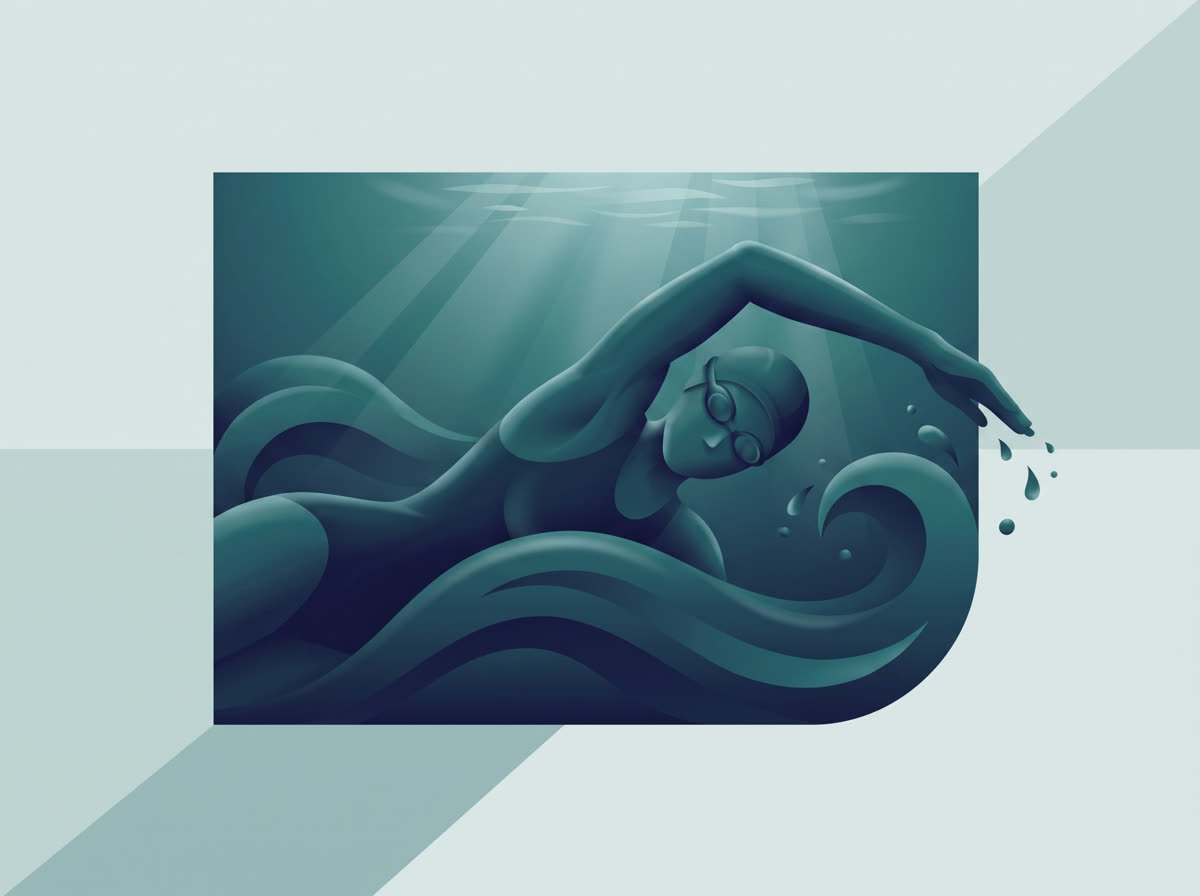
What is body undulation in butterfly?
It is the wave that travels from your chest down to your feet, twice per arm cycle. Your chest and your hips take turns being the low point. When the chest presses down, the hips rise. When the chest comes back up, the hips drop and the legs finish the wave with a kick.
That rise and fall is not style. It is the transport system of the stroke. The kick in butterfly does not start at the knees, it starts higher up the body and arrives at the feet, so if the wave never leaves your chest, your legs are kicking on their own with nothing feeding them.
Where should the wave start?
At your sternum, not at your knees and not in your lower back. The sequence runs chest, ribs, hips, thighs, feet, in that order, and each segment should move a beat after the one in front of it.
Get the start point wrong and you get one of two broken strokes. If the wave begins at your knees, you are riding a bicycle: the legs churn, the trunk stays flat, and nothing travels. If it begins at your lower back, you are hinging instead of flowing, which arches you, lifts your head and costs you the line.
How much undulation do you actually need?
Less than most swimmers make. You need enough to let your hands clear the surface on the recovery and enough for the kick to reach your feet. Everything past that is motion that does not go forward.
Here I will be honest rather than precise. Written guidance on how much undulation to use is vague, and I will not invent a number of centimetres for your body and your speed. What I can give you is what I look for from the deck.
Too much looks like this: the hips breach and throw spray, the heels come clean out of the water on every kick, the head lifts on the entry, and the stroke rides up and down more than it travels. A fly that is mostly vertical is loud.
Too little feels worse. The hands catch the water on the way forward and the recovery turns into a shrug through the shoulders. The hips never come back to the surface, so every entry starts with your body pointing slightly downhill, and your chest pushes water for the whole length.
The frontal area argument settles most of it. You are only fast in butterfly while your body is close to level, because the more your trunk is angled against the way you are swimming, the more water you have to shove aside. A big wave spends more of each cycle at a steep angle. A small, well timed wave spends more of it long and flat.
Why does pressing your chest down lift your hips?
Because your body pivots roughly around its middle in the water, so pushing one end down brings the other end up. You are close to neutrally buoyant, you are not standing on anything, and your hips sit near the point the whole thing rotates about. Press the chest and the hips have to come up.
Swimmers resist this, because when the hips sink the instinct is to lift the chest and haul yourself out of the hole. That makes it worse: lifting the chest drives the hips further down and tips the body into a steeper angle, so the next recovery has to come around a bigger obstacle.
Press forward and slightly down, not straight down. A press that is too hard and too vertical takes your arms deep with it, so you buy a hip lift and pay for it with a pull in the wrong place. The butterfly arm pull depends on the hands staying high enough to set the catch.
How does the undulation fit with the two kicks?
Each kick is the end of one wave, which is why there are two per arm cycle. The press at the entry starts the first wave and the first kick finishes it. The chest coming back up through the pull starts the second, and the second kick finishes it as your hands leave the water.
So the kicks are not two events bolted onto the stroke. They are the tail end of two body movements, and the reason the butterfly second kick is the one almost nobody has is that the second wave gets lost when swimmers tire and start swimming with their arms alone.
To feel the wave on its own, with no arms in the way, use the underwater dolphin kick off the wall. Same sequence, same start point, no recovery to worry about.
Why does your lower back do the work instead of your hips?
Because you are making the wave with your spine rather than flexing at the hips. The shape looks similar from above the water and feels completely different inside the stroke. A spine wave arches you backwards on the recovery and jackknifes you on the press.
The correction is to press from the sternum with the ribs staying stacked, and let the hip joint do the bending. I describe the same mechanism from the other side in lower back pain in breaststroke, because the two strokes go wrong in the same way.
How do you get help with your butterfly undulation today?
Not sure what to fix first? Take the 60-second swim check at swimread.com/check.
What should you drill this week?
Take the arms out of it first. You cannot feel a wave you are interrupting twice a second.
- Body dolphin, arms at your sides, face down. Breathe when you need to. One job: start the movement at your chest and feel it arrive at your feet. If your knees lead, you have found your fault.
- Butterfly kick on your back, hands at your sides. The surface shows you the truth. You want a flowing rise and fall through the trunk, not two knees breaking the water.
- Three kicks, one stroke, over 25 metres. Separates the waves so you feel two per cycle instead of a blur.
- Single arm butterfly, other arm extended in front. Keeps one side long so the press has something to travel along.
- Four by 25 metres fly, eyes on the bottom until you need air. Head down keeps the chest working forward rather than up.
Time those 25s in my free swim pace calculator and check the rhythm paid you back in speed, not just in how the stroke felt. If the whole stroke still needs assembling, start from the butterfly hub.
The SwimRead app isn't out yet, so there is nothing to film for it today. If you want help with your butterfly now, take the 60-second swim check.