
Tension never shows up on the clock as tension. It shows up as a stroke that falls apart in the third length, a neck that aches after an easy swim, and the sense that the pool asks more of you than the bike does at the same effort.
I raced the 200 individual medley at two Olympic Games, and what separates an easy swimmer from a busy one is almost never strength. It is how much of the body is working at any moment, and how much is allowed to do nothing.
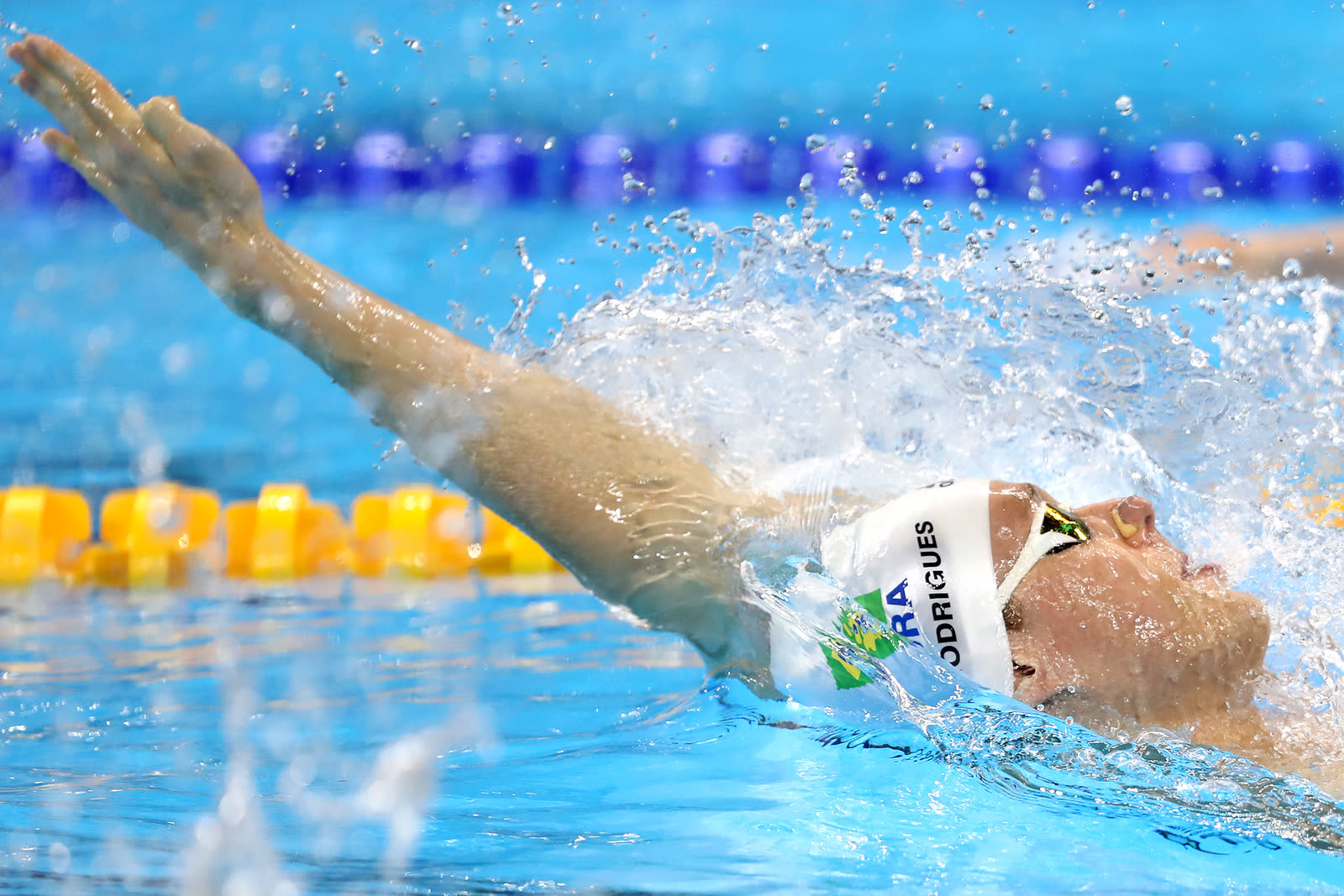
Why does freestyle feel so tense even when you are swimming easy?
Because water charges you for every bit of effort that does not point forward, and a tense adult produces plenty of it. A stiff trunk stops rotating, a clenched hand slips, a head held up drops the hips. Coach Scott Bay names the bill in Master Freestyle, writing for U.S. Masters Swimming: "If you carry a lot of tension in your upper back and neck you are recruiting muscles to do work that do not help you swim better or faster."
You are not short of fitness. You are spending it on muscles that move you nowhere, and adults spend it in the same four places: neck, hands, the arm coming over the top, ankles.
Should your neck be relaxed or holding your head in place?
Relaxed, and in line with the spine rather than propped up. Master Freestyle is unambiguous: "We advocate relaxing the neck to a neutral position." Neutral means the head rides where the spine puts it, so the water line crosses it on its own. The U.S. Masters Swimming freestyle guide describes the habit that breaks that: "Swimmers often lift their head up and to the side to breathe." The cost lands immediately, because "This causes their hips to sink and their shoulders and hips to move from side to side, increasing drag."
So a tense neck sinks your legs, the quiet reason your legs drag behind you however hard you kick. Where to point your eyes is in head position in freestyle. Once the head goes quiet the body can turn, which the guide treats as the hinge of the stroke: "The rotation of your body is the central skill around which all skills are timed."
Do you have to squeeze your hand to hold the water?
No, and squeezing makes the hand worse. Bay is blunt in two words in The Three Rs of Efficient Distance Freestyle: "Relax the hands." A rigid hand fights the water instead of leaning on it, which is why he pairs the cue with its purpose: "Relax the hand and try to hold the water."
Relaxed is not floppy, though, and this is where adults overcorrect. The paddle runs from the fingertips to the elbow, and it works only in one piece. Master Freestyle sets the line: "Although fingers are relaxed, any break in the wrist weakens your paddle and reduces propulsion."
Why does the recovery arm get so tired?
Because most adults carry it over instead of letting it fall. That arm does no propulsive work, so effort spent on it is pure cost, and Terry Heggy lists where the cost hides in freestyle recovery drills: "No energy is spent clenching fingers, lifting elbows too high, or decelerating the hand before entry."
An elbow forced up by the shoulder, rather than lifted by the body turning underneath it, works against gravity for nothing. The shape of the arm matters less than what it costs you, which is the point of high elbow recovery in freestyle, and the rotation that makes it cheap is in freestyle body rotation.
How does your breathing make you tense?
By being held. The Three Rs tells distance swimmers not to hold the breath, not even briefly: "Even for a second." Holding air does not only starve you of it, it stiffens you: "It flexes all the muscles in the core and that actually takes oxygen out of the system."
The companion article on exhaling sets the same rule for any real distance: "If you're swimming any sort of distance at all, you should not ever hold your breath."
Keep the air moving and the breath stops being an event, which is why a fit adult can gasp after two lengths. The guide gives the standard: "A great breath is one that's not noticeable." The progression is in how to breathe in freestyle swimming.
Can loose ankles kick better than stiff ones?
They can, and pointing your toes hard is what takes the kick away. The Three Rs gives the image I use on the pool deck: "The mental cue we use is to think of your knee and ankle joints being connected with a single rubber band." A stiff ankle locks that band, so the foot stops finishing what the hip started. Bay explains why the looser joint wins: "Leaving them looser allows for the stronger muscles to do the work and let the leg finish the kick." Hip starts it, knee stays soft, foot trails. A small, cheap kick is in two beat kick freestyle.
How will SwimRead read this part of your stroke?
The app isn't out yet. When it launches, it will read positions, not feelings, because no camera sees tension directly. What it will see is what tension produces: a head riding high, hips low, an elbow going up while the body stays flat. The home page describes the method as pose estimation, where "On-device pose detection estimates up to 33 body landmarks in sampled video frames."
Film from the side, the app's one supported view: "At launch, the app will analyze freestyle filmed from the side of the pool." The page asks you to "Aim for 10 seconds of continuous freestyle," filmed "in landscape from the side, with the whole body visible." Whole body visible matters here, since the neck, the recovering arm and the ankles are what you are checking.
It is careful about what comes back, and so am I. "These estimates are not validated technique grades," and "The app does not grade technique or automatically retrain itself after each analysis." The interface preview offers a focus such as "Head position," labelled plainly as "Your choice, not a detected technique problem." Treat the clip as evidence, then take one thing to practice.
What should you practice this week?
- One length with soft hands. Swim normally, thinking only about the fingers. If the forearm tightens, you squeezed.
- 4 x 25 neck check. Head neutral, eyes down and a little forward, water line where it falls on its own.
- 4 x 25 one arm at a time. Heggy suggests you "think about one arm at a time (odd lengths left, even lengths right, for example)," which finds the arm that works harder.
- One length of continuous bubbles. Face down, air leaving the whole time, never stored.
- One length of trailing ankles. Kick from the hip, knee loose, toes untensed. Stop pointing and let the foot follow the leg.
Build the effort last. Heggy warns that "What's easy at a relaxed pace may become challenging with increased intensity," so he advises you to "Try ramping up the effort levels in tiny increments while holding onto proper form." For a number to hold that easy pace against, use the swim pace calculator.
The SwimRead app isn't out yet. If you want help with your stroke today, take the 60-second swim check.