
You push off in the middle of your lane. Six strokes later your fingers scrape the lane rope, or your shoulder bumps the swimmer coming the other way. You correct, push off again, and it happens again in the same direction every length.
Most people blame the lane, the rope, or a crooked push off the wall. It is none of those. If you drift the same way every length, your two sides are not doing the same job. A drift is also one of the easiest faults to find, because the black line on the bottom measures it for you.
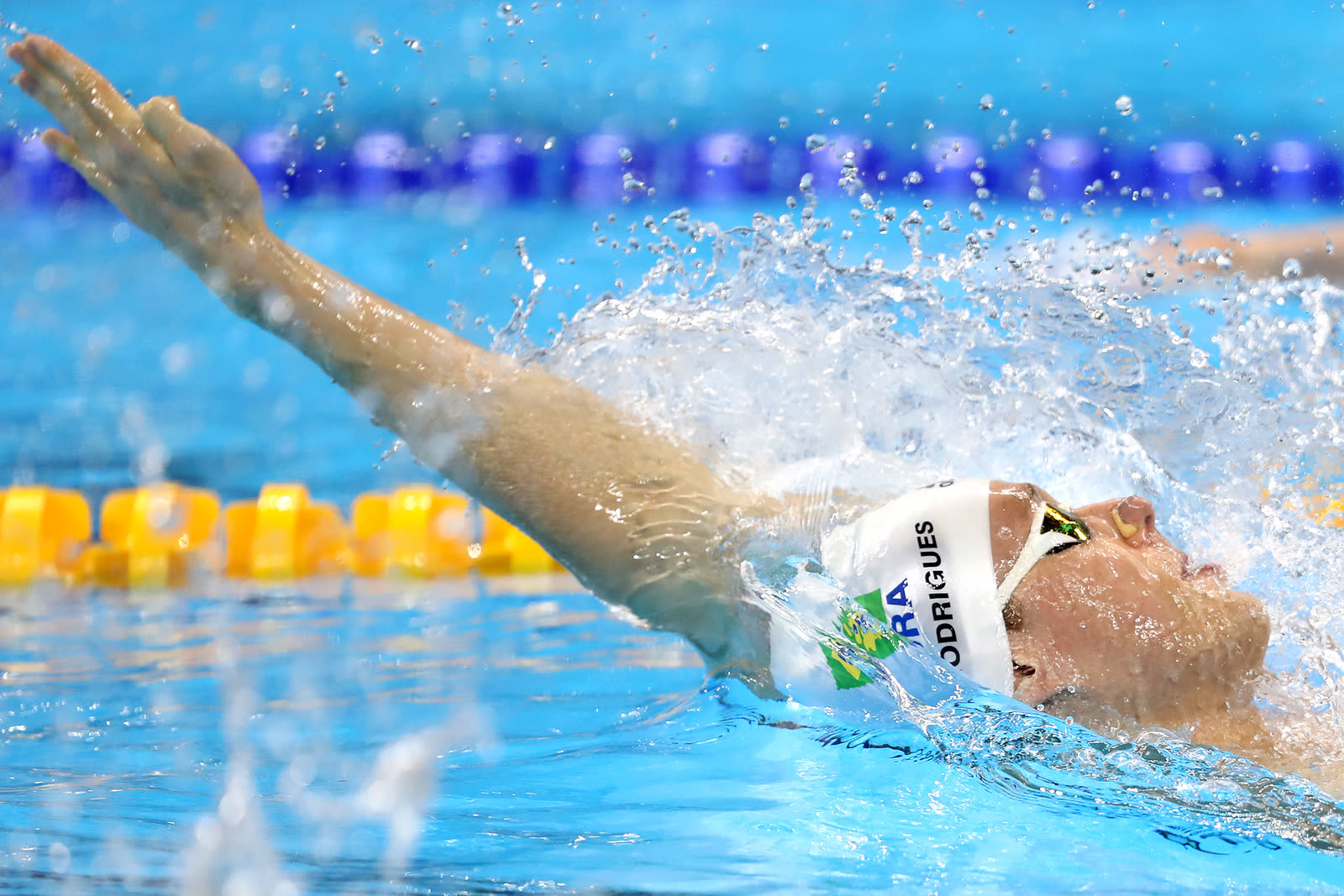
Why do I drift to one side when I swim freestyle?
Because your left stroke and your right stroke are not mirror images, and in the water any difference between them becomes a steering input. On land your feet fix your direction. In the water you are a long object balanced on nothing, so whichever side pushes more water sideways turns you a little on every stroke. Twenty strokes of a small error adds up to a lane rope. Below are the three faults that usually create that difference, in the order I would check them.
Is a crossover at the hand entry what pushes me off line?
Usually yes, and it is the most common cause by a wide margin. If one hand enters past the middle of your body instead of in front of its own shoulder, that hand has to sweep back out to the side before it can press backward. The outward sweep pushes water sideways, and that turns your hips the other way, once per stroke cycle, always in the same direction.
Swim with your eyes on the black line and watch where each hand lands. The hand that crosses the line on entry is the one steering you. Most swimmers cross over on one side only, which is why the drift goes one way. A crossover on both sides makes you snake instead of drift.
The fix is not a thought, it is a landmark. Enter each hand in front of its own shoulder, fingers pointing down the pool rather than across it. For where the hand should land and what the wrist should do, see freestyle hand entry.
Why do I only drift when I breathe to one side?
Because breathing to one side loads that side and unloads the other. When you turn for air, the head turns, the lead arm tends to press down and inward to hold you up, and the stroke on that side slows while you wait. The other arm works on its own and gets shorter and hurried. Breathing every two strokes repeats that asymmetry for the whole length, and the drift is the sum of it.
This is the best reason to breathe to both sides, not as a badge of a real swimmer but because it forces both halves of your stroke to carry the same load. If you have never tried it, start with bilateral breathing in freestyle and treat it as a straightness drill.
Can a crooked kick push me sideways?
Yes, and the usual culprit is the scissor kick you make when you breathe. One leg swings wide and crosses behind the other, which is your body stopping itself from rolling too far while you turn for air. A wide leg is a large surface moving sideways, so it does not just slow you down, it steers you. A scissor on the breathing side only gives you a reliable one way drift, and it often travels with the crossover above, since both come from over rotating for air. The correction is in the freestyle scissor kick.
How do I find out which side is actually the problem?
Measure it instead of guessing, because the side that feels wrong is usually not the side that is wrong. One rule first: do not lift your head to check where you are going, since that drops the hips and shortens the stroke you are taking, which steers you more. The line, the rope at the edge of your goggles and the T on the bottom tell you everything, so keep the crown of your head pointed down the pool, as in head position in freestyle. Three tests, in order of how much they tell you.
Start with the line test. Swim a length with your eyes on the black line and notice where your body sits relative to it. Most drifting swimmers are not centered on it, they sit to one side the whole way and correct without knowing.
Then the closed eye test, in an empty lane with nobody coming the other way. Push off from the middle, take six to eight strokes with your eyes closed, stop and look. Whichever way you travelled is your drift direction, with nothing hiding it. Repeat three times to be sure it is consistent.
Last, count your strokes per length on each breathing side, one length breathing only left, one only right, same effort. If one takes two or three more strokes than the other, the shorter side is doing more of the work. For a baseline count, see how many strokes per length is good in freestyle.
What should you practice this week?
Pick one per swim. Do not try to fix every cause at once, because they interact and you will not know what changed.
- Single arm, problem side only. One length with the drifting arm doing the whole stroke, the other extended in front. Watch the hand enter in front of its own shoulder every time. Six to eight lengths, easy swimming in between.
- Fingertip drag with a line check. Normal freestyle, fingertips brushing the surface on the recovery, eyes on the black line, your only job to notice which hand crosses it. Noticing is the drill.
- Breathe every three for one length in three. Every third length of your warm up. This is not lung training, it forces both sides to pull the same.
- Kick on your side, both sides. Twenty five yards on the right, twenty five on the left, lower arm extended, face down, rolling just enough to breathe. The cheapest way to find out that one side holds you up and the other panics.
- The closed eye check, once a month. Not a drill, a measurement. Is the drift shrinking?
Two or three weeks is usually enough to see a difference, because you are not building fitness here, you are removing a sideways push.
Where can you get help with your own drift today?
You can take this exact problem to SwimRead Club. You describe what feels wrong, answer a few yes or no questions, and get your first fix free, with no card needed. That free fix covers the likely cause, a way to check it on your next swim, and the feeling to look for, which is what a drift needs, because the cause is usually not the side you suspect.
Membership is $9.99 a month and adds the full drill, a four week plan, your next fixes in order, and a library the page describes as over 200 fixes and 150 drills. It renews automatically every month until you cancel, and you can cancel anytime online. The SwimRead app isn't out yet, so the Club is where the help is today.
A drift is not a sign that you are a bad swimmer. It means one side of your stroke is stronger, longer or earlier than the other, and that is measurable and fixable. Find the side first, fix the entry second, and let the black line tell you whether it worked. If you want someone to point at the likely cause for you, take the 60-second swim check.