
Almost every adult swimmer has a side. Ask them to breathe to the other one and the stroke comes apart: the arm slaps in, the legs split, the hips drop. They reach the wall convinced they have found a disability. What they have found is that half of their stroke has never been asked to do anything.
Bilateral breathing is one of the most argued about rules in swimming. Some coaches sell it as compulsory, others call it a myth that costs you air. I swam the 200 individual medley for Brazil at two Olympic Games, and sixteen years in high performance taught me that both camps are describing different things under one name. One is a training tool. The other is a racing decision.
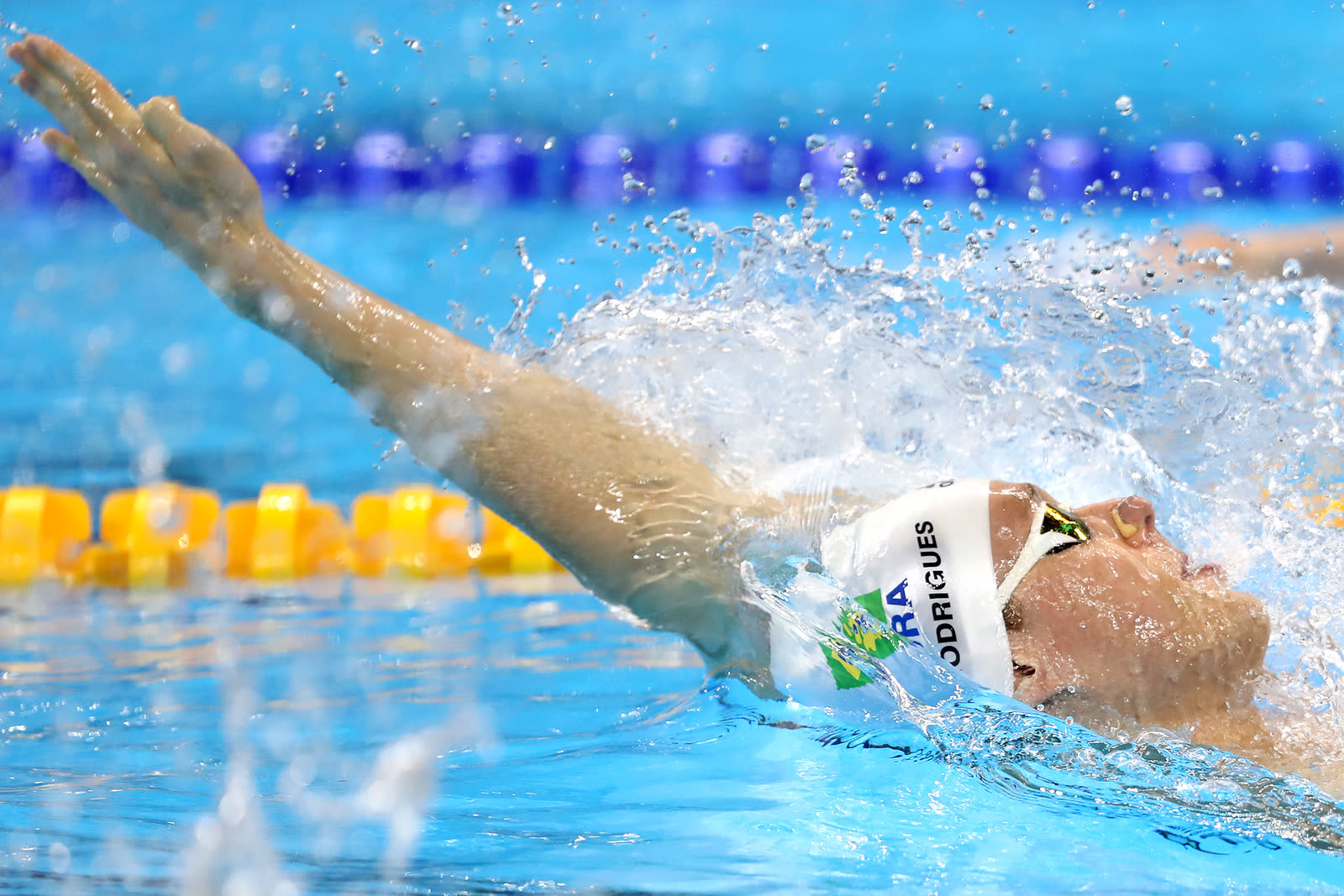
What is bilateral breathing in freestyle?
Bilateral breathing means taking your breath to both sides, most often by breathing once every three strokes so the breath alternates left, right, left. The switching is pure arithmetic: an odd stroke count puts your head on the opposite side each time, while an even count keeps it on the same side forever. Breathing every two strokes, which is what most swimmers do without ever deciding to, is by definition one sided.
The number three is not sacred, so what matters is whether your stroke is ever required to work with your head turned the other way. If the answer is never, you do not have a breathing preference. You have a stroke that only exists in one mirror image.
Why does breathing to one side only make you crooked?
Because a breath is a rotation, and a rotation you only ever perform in one direction becomes the shape of your stroke. To clear your mouth you let the roll go a little further to the breathing side, and done every second stroke for a few thousand kilometres, that extra roll stops being a choice and becomes something you are.
This one has been measured. A 2022 study in Sensors, The Effect of Breathing Laterality on Hip Roll Kinematics in Submaximal Front Crawl Swimming, put 18 elite competitive swimmers through three 100 metre front crawl trials in a 25 metre pool: preferred side every two strokes, each side once every three, and a snorkel. The paper reports that "Peak hip roll to the preferred side was significantly greater (p < 0.001) in the unilateral condition", and concludes that "both bilateral and snorkel breathing successfully reduced unilateral roll asymmetry".
Read the conditions before the conclusion. Those swims were at a submaximal velocity equivalent to 70% of each swimmer's season best 100 metre time. That is training pace, so it says plenty about what your everyday pattern does to your roll and nothing about what to do when the race hurts.
The lean is not the real cost. Everything hanging off it is. An over rotated breath pulls the lead arm across the centre line, which is where crossover at hand entry comes from, and it drops the hips, the mechanism behind the scissor kick that opens on your breathing stroke. My post on freestyle body rotation covers how much roll you want. One sided breathing pushes you past it on one side only.
Is breathing every three strokes slower than every two?
At easy aerobic pace, for a trained swimmer, usually not. At race pace, often yes. Air is a requirement, not a preference, so hold a pace that needs a breath every second stroke, take one every third, and the payment comes out of your stroke: the catch gets rushed, the kick gets loud, the last 15 metres disappears. The two patterns are different tools, not a right and a wrong answer. To judge a change, watch the splits rather than the feeling, because the swim pace calculator turns your per length times into the pace you would hold over the full distance.
Should you breathe bilaterally when you race?
Mostly no, and this is where the rule gets oversold. In a race you breathe when you need air, on whichever side delivers it, and nobody has ever been disqualified for asymmetric hip roll. Training bilaterally is about arriving with a stroke that is not bent, and a second side that works when the lane beside you is churning or the sun sits on one side in open water. You build with the pattern and spend it in the race.
How does SwimRead read your breathing pattern?
With the same short side view clip the rest of the app is built on. SwimRead's home page says the current beta supports freestyle filmed from the side of the pool, and the capture guide asks for about 10 seconds of continuous freestyle, filmed in landscape with the whole body visible, a stable camera, standard lens and normal playback speed, with no need for a full pool length. Ten seconds is enough for a breathing pattern to show itself, because an alternating pattern has to change sides inside that window and a one sided one never does.
On device pose detection estimates up to 33 body landmarks in sampled frames, and the report distinguishes the measurements that are available from the categories the video cannot support. The page is explicit that these estimates are not validated technique grades and that the beta does not assign a technique score. What it holds instead is a history for each swimmer and a focus you choose yourself, which the page notes is your choice rather than a detected problem. For this fault that is the right shape, because breathing symmetry is not one number. It is the same swimmer, filmed the same way, a few weeks apart.
Which drills build your weak breathing side?
Do not start with 400 metres breathing every three. Start by making the bad side survivable.
- 8 x 25 breathing every two strokes to your weak side only, easy pace. One length is short enough that air never becomes the problem, so the stroke gets to be instead.
- 6 x 50 as 25 weak side, 25 strong side. Notice the difference before trying to erase it.
- 8 x 50 breathing every three, at a pace slow enough to stay comfortable. If it is not comfortable, the pace is wrong, not the pattern.
- 4 x 100 as 50 every three, 50 every two, same stroke count on both halves. This one exposes whether the pattern is changing your stroke length.
- Any kick or pull set with a snorkel, as a reference for what an unbroken roll feels like with no breath in it.
Keep a usable share of your aerobic work on every three for six to eight weeks. That is long enough for the weak side to stop being an event.
How long does the bad side take to feel normal?
A few weeks of consistent exposure, not a few lengths. The first sessions feel clumsy and airless, then the clumsiness goes, then one day you breathe to the old bad side and nothing happens. Nothing happening is what a symmetrical stroke feels like from inside.
The trap is judging it by feel. A one sided stroke feels perfect, because it is the only stroke you have ever felt, and the lean is invisible from inside your own goggles. That is the kind of fault I built SwimRead for: a coach sees it in one length from the deck, and most adult swimmers do not have one. SwimRead's home page states that it is free while in beta and that you leave your email for an invitation as spots open, so join the beta and film ten seconds of the side you never breathe to.