
I swam the 200 individual medley for sixteen years, which means backstroke was never optional. It was one quarter of every IM I raced, and it was also the leg where a small technical error cost the most, because you cannot see the wall coming and you cannot see your own stroke while you swim it. Freestyle mistakes get caught on video eventually. Backstroke mistakes just feel like normal swimming until someone points a camera at you.
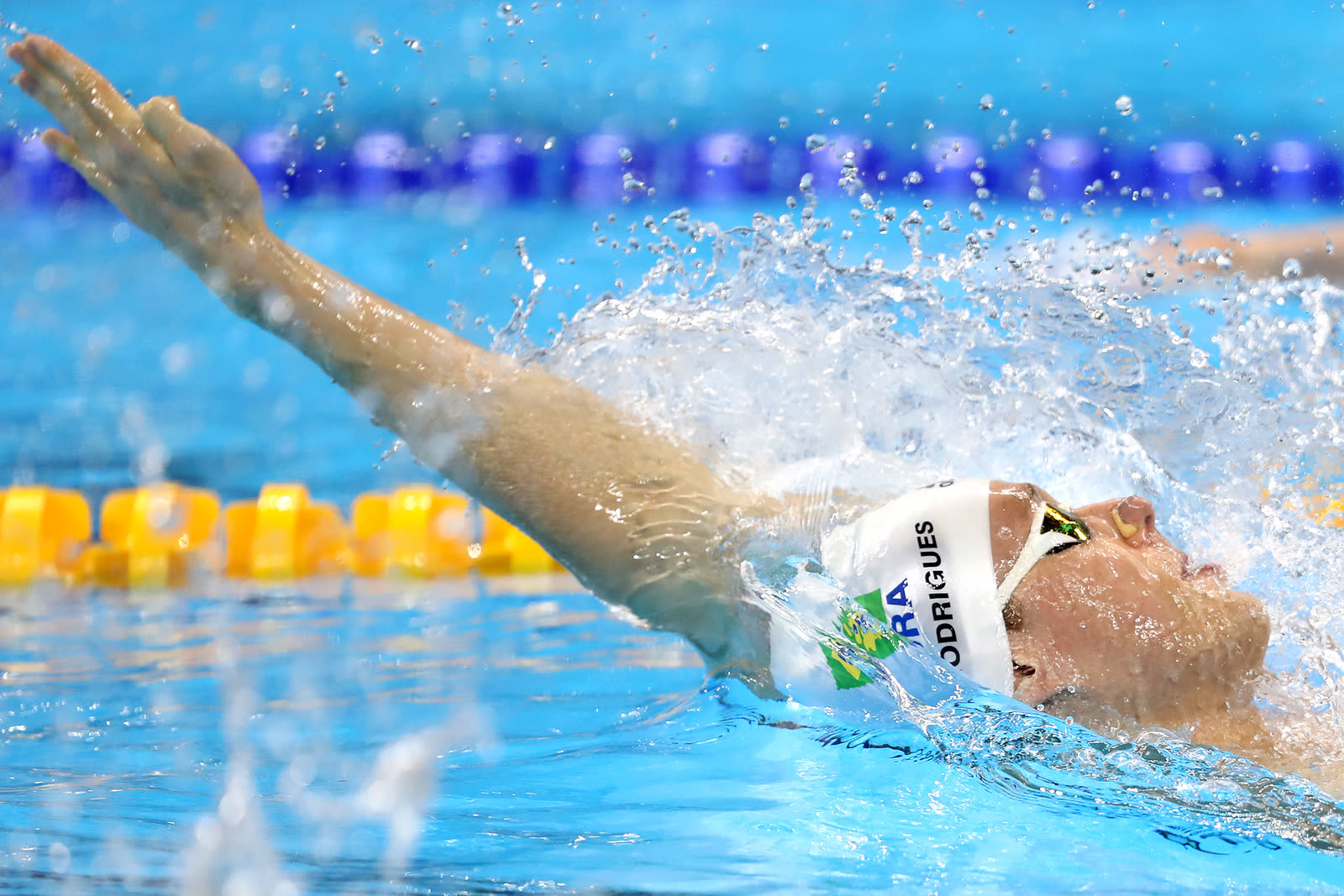
Why does body position matter more than arm strength in backstroke?
Because you swim it on your back, and a low body position drags directly against the direction you are trying to move. In freestyle a sinking hip mostly costs you streamline. In backstroke, sinking hips and a dropped head tip your whole frame into a shallow V, so every stroke is spent fighting your own posture instead of moving forward. No pull is strong enough to out-muscle that.
The fix starts at the head, not the hips. Keep your head still, chin slightly tucked, eyes looking straight up at the ceiling rather than back toward the wall you are approaching. A backstroker who lifts the head to check position drops the hips every single time, because the body follows the head. Think of your head as the anchor point for the rest of the line: still head, level hips, flat back. Everything else in the stroke gets easier once that line holds.
How much should you rotate in backstroke?
About the same amount you should rotate in freestyle, just executed on your back instead of your front. Backstroke is really freestyle's mirror image: the same long axis roll, the same reason for doing it, reach on the extending side and a stronger connection to your lats and core on the pulling side, without the shoulder having to do all the work alone. Swimmers who keep their shoulders flat and pull with the arm only end up short and strained, exactly like flat freestylers do. I go through how much roll is enough and how much is too much in how much you should rotate in freestyle, and the same calibration logic applies here. If anything, backstroke punishes under-rotation harder, because a flat backstroker also loses the clean line that keeps the hips up.
Where should your hand enter the water in backstroke?
Just outside the line of your shoulder, pinky first, not crossing over your face toward the centerline of your body. A hand that enters wide and crosses inward forces internal rotation at the shoulder, the same compromised position I write about for freestyle in the freestyle catch, and it steers your whole body off its line stroke after stroke. You end up snaking down the lane instead of swimming straight, which is slower even before you account for the wasted energy correcting course.
Enter with the arm fully extended, not bent, so the shoulder does the reaching rather than a short forearm punch. Once the hand is in, bend at the elbow so your forearm and palm can press water straight back toward your feet. That single motion, straight-arm entry followed by an early bend at the elbow, is the difference between a pull that grips the water and one that slides through it.
What does the kick actually do in backstroke?
Less than most swimmers assume, and its real job is keeping your hips up and your rotation timed, not driving you down the pool. Backstroke propulsion comes mostly from the pull. The kick is there to stabilize the line your arms are trying to build. A weak or lazy kick lets the hips drop the moment you stop paying attention to them, undoing the body position work from a good head and rotation.
That means the kick deserves attention on every length even though it rarely feels like the exciting part of the stroke. Keep it compact and continuous rather than big and occasional. A kick you only remember to do when you think about it is not doing its job the rest of the time.
How do you stop misjudging the wall in backstroke?
By counting strokes from a fixed visual marker instead of guessing. Every competition pool hangs a set of flags above the water on each end specifically so backstrokers have a landmark that does not depend on turning around to look. Find your personal stroke count from the flags to the wall once, in practice, at your normal race tempo, and trust that number instead of craning your neck at the last second. A late head lift to check distance is one of the most common ways swimmers scrape a wall or, just as often, glide in too early and lose a full stroke of speed doing it.
This is a rehearsal problem, not a talent problem. Count it enough times in training that the number becomes automatic, the same way you would rehearse a turn.
Which drills fix backstroke technique fastest?
Three drills, tackling head position, rotation and the catch separately so you are never trying to fix all three at once.
- Head-still lengths. Swim easy backstroke thinking about nothing except keeping your head dead still, eyes on the ceiling. Let the stroke fall apart a little if it has to. This isolates the one fault that undoes everything else.
- Single-arm backstroke. Swim with one arm working while the other stays pressed to your side, switching arms each length. It exposes a weak catch immediately, because there is no second arm to cover for it, and it forces you to rotate to reach full extension.
- Six-kick switch drill. Kick on your side, one arm extended overhead, for six kicks, then roll and switch to the other side and repeat. This trains the timing between kick and rotation directly, at a pace slow enough to actually feel it.
Do these as a short set before main backstroke work, not as a substitute for it. Drills build the pattern, full-stroke swimming at pace is where you prove it holds up under fatigue. Once your stroke feels more consistent, testing it against the clock tells you if it is actually getting faster. My free swim pace calculator turns a simple time trial into training paces, so backstroke sets have a real target instead of a guess.
Outside the current supported analysis: backstroke. SwimRead is a swimming video review app, currently in beta. It supports short, side-view freestyle recordings, shows which automatic measurements are available, and keeps a history and chosen training focus for each swimmer. It does not grade technique or establish that a specific error was detected. Video stays on the phone; technical measurements and body-landmark coordinates are sent as described in the Privacy Policy. Join the beta waitlist for an invitation as places open.